

”Apoplus”, June-July 2019, Hellenic Ministry of Culture and Sports, Old Fortress of Corfu
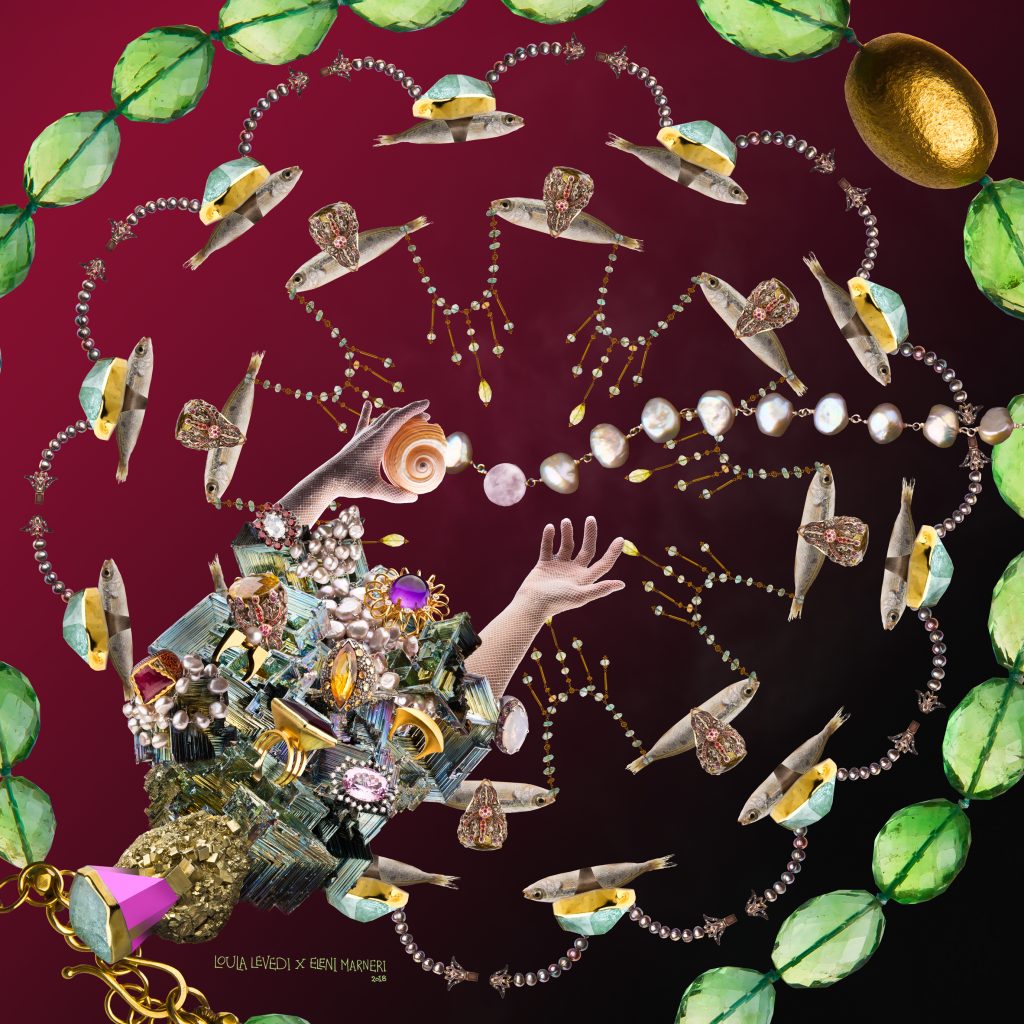
Happy and honored to be part of ”Apoplus” organised by the Hellenic Ministry of Culture and Sports with two silk scarf artworks, the one comissioned from Eleni Marneri Gallerie and the other inspired from the same gallery. Apoplus is a multimedia exhibition focusing on the port as the place of cultural exchange and symbol of advent and departure during man’s journey. Important benchmark of the exhibition, the invisible cities of Italo Calvino bringing out the nature of port.
My two artworks refer both symbolically and pragmatically to the essence of ”valued” and ”precious” in the form of the jewelry itself in contrast and in harmony with the natural ornaments of the universe such as the Moon , the Fish, the Shell etc. Moreover even the printing material is chosen to be silk refering to the products people used to exchange or buy near ports that are symbols of wealth , cultural exchange , action and narrative.
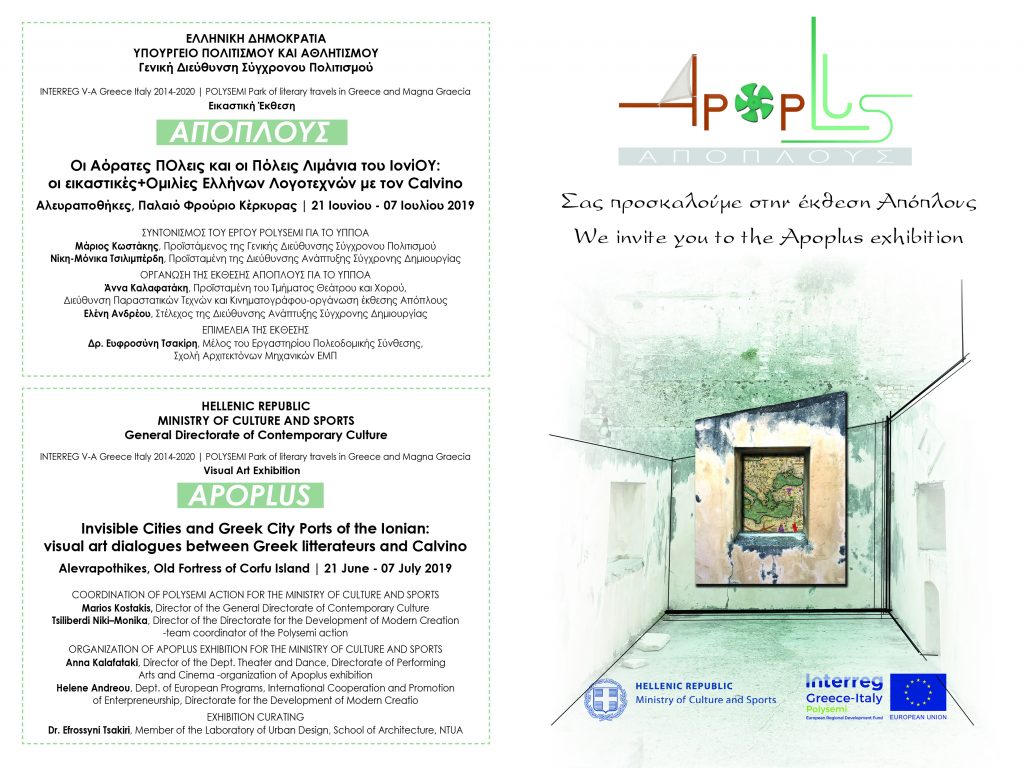
”The Exhibition APOPLUS, Invisible Cities and Greek City Ports of the Ionian: visual art dialogues between Greek litterateurs and Calvino, is organized by the Hellenic Ministry of Culture and Sport, General Directorate of Contemporary Culture, in the framework of the action “Park of literary travels in Greece and Magna Graecia”, with the acronym POLYSEMI of the “INTERREG V-A Greece Italy Programme 2014-2020“. The exhibition will be hosted at Alevrapothikes building in the Old Fortress of Corfu. The exhibition will be inaugurated on June 21 and will run until 7 July 2019.
Curating: design, implementation, scientific documentation, Dr. Efrossyni Tsakiri Architect, member of the Laboratory of Urban Design, School of Architecture NTUA
Project organizer and coordinator for the HMCS, Anna Kalafataki, Director of Department “Theater and Dance”
In the Flotilla fresco, the oldest known representation of a port found in the Akrotiri excavation in Santorini, the eastern part is called “Apoplus” (sailing). The exhibition focuses on the exploration of this polysemic concept, creating a multifarious environment that refer to the port as an intermediate space, a threshold between the city and the sea. Metaphorically, port, city and sea will become the symbols for action, the inner world of man and the journey of life. The complex structure of the exhibition creates semantic frameworks, which the visitor is called upon to desymbolize in the experience of his wandering.
An important inspiration for the design of the exhibition was the text Invisible Cities of the Italian litterateur Italo Calvino, an exemplary presentation of the multifarious nature of the city-port. The text brings in a common narrative a variety of city descriptions that eventually appear to form the multiple facades of one and single city, Venice. In addition, through the dialogues and descriptions of the cities in the text, one can discover various other dynamic interactions, such as the dialogue between two cultures, let’s say Greek and Italian, or the interaction of text and image. The Invisible Cities are fantastic. Through the exhibition they are invited to interact with the ‘visible’, real cities of the Ionian Sea as described in the work of Greek Ionian litterateurs, such as Andreas Kalvos, Dionysios Solomos, Kostas Karyotakis, Lefcadio Hearn, Aggelos Sikelianos, Elisavet Moutzan Martinengou, Maria Polydouri, as well as with cities of Magna Grecia in Italy, through the corresponding ‘Griko’ musical tradition.
The design of the exhibition is inspired by Alevrapothikes, a building of cultural importance in the Old Fortress of Corfu, and aims to create thereby an atmospheric audiovisual environment, highlighting its unique aesthetic quality that combines elements, such as the stone architecture, the patina of time, the location in the trench. Alevrapothikes spaces, both indoor and outdoor, will be carriers of meanings, protagonists that embody roles and implement the narrative context of Apoplus. The perception of city–port will be formed through the interaction of images and sounds. The visitor of the exhibition will wander around and re-create fragments, forming multiple and flowing versions of Apoplus from the intertwinement of actions, experiences, narratives.
More than 80 artists from Greece and abroad, individually and in groups, participate in the exhibition with works of contemporary art, that include paintings, photographs, engravings, sculptures, site specific installations, soundscapes, video projections, and so on. In the attempt to combine science, research and experimentation with well-established forms of art, the exhibition will host both prominent and young artists (students and graduates of visual art schools).
The exhibition has the scientific support of the Urban Design Laboratory of the School of Architecture, NTUA. In the scientific documentation of group installations contributes also a group of artists and academics, coming from institutions such as the School of Architecture NTUA, the Ionian University, the School of Architecture TUC, the Department of Interior Architecture UniWA, the Hellenic Open University and the Syros Institute.”




Sorry, the comment form is closed at this time.